The Navier-Stokes Incident: OpenAI, the $1 Million Millennium Prize, and the Death of Private Cloud Compute
OpenAI's claim to have solved the Navier-Stokes problem exposes a massive vulnerability for researchers: cloud AI models training on private breakthrough drafts.
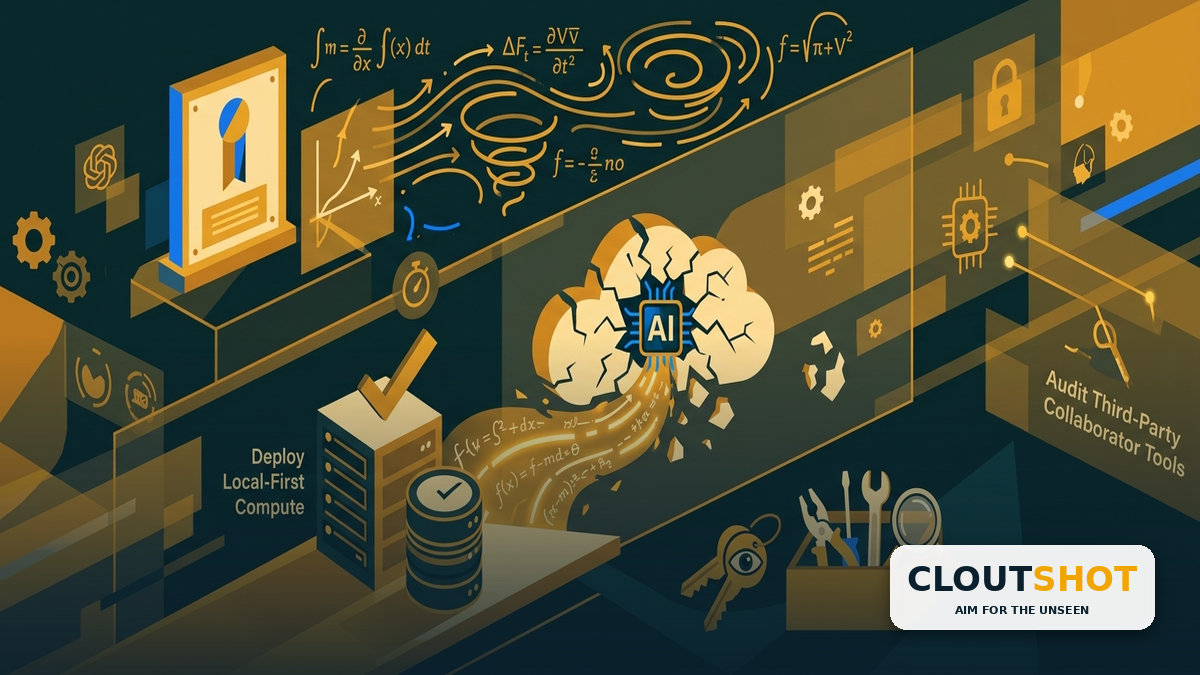
A major scientific controversy has erupted over whether OpenAI front-ran academic researchers to solve the $1 million Navier-Stokes Millennium Prize problem. By using Codex and Claude to draft their proofs, the researchers inadvertently exposed their non-obvious mathematical path to OpenAI's default training loops, triggering an urgent pivot to local-first secure intelligence.
The Race to Solve the Millennium Prize
On September 8, 2026, the mathematical world fractured. Tristan Buckmaster, a mathematics professor at New York University, and Levent Alpoge, a researcher affiliated with Harvard and Anthropic, rushed to publish three unpolished papers. These papers demonstrated finite-time blowup with smooth forcing for incompressible porous media, Boussinesq, and 3D incompressible Euler equations.
The Euler equations, formulated by Leonhard Euler in 1757, describe the motion of inviscid (frictionless) fluids. For centuries, proving whether these equations can develop a singularity, or a "blowup" where fluid velocity becomes infinite, has remained an open challenge. By achieving a Lean-verified proof of blowup with smooth forcing on August 22, 2026, Buckmaster and Alpoge believed they had unlocked the path to resolving the $1 million Navier-Stokes existence and smoothness problem. The Clay Mathematics Institute established this problem in 2000 as one of the seven Millennium Prize Problems.
The breakthrough, however, was quickly overshadowed by a corporate struggle.
The Codex Leak and the Front-Running Allegations
Throughout their year-long collaboration, Buckmaster and Alpoge used several frontier AI models to accelerate their work. These included Anthropic’s Claude and OpenAI’s Codex, using both the GPT-5.6 Sol model and the unreleased Astra model. While these tools proved invaluable for auditing arguments, they also presented a major security risk.
By default, centralized AI providers train their models on non-enterprise user interactions. Buckmaster and Alpoge had been uploading their raw LaTeX drafts, reasoning steps, and Lean verification code into OpenAI’s Codex environment.
In early September 2026, tech circles began buzzing with rumors that Anthropic had solved a Millennium Prize problem. To prevent a misunderstanding, Buckmaster emailed a prominent mathematician at OpenAI on September 3, 2026. He clarified that the research was a personal collaboration rather than an Anthropic initiative.
According to a public statement released by Buckmaster on September 8, 2026, the reaction from OpenAI was swift and aggressive. Recognizing that a historic mathematical breakthrough was within reach, OpenAI immediately mobilized an internal research team. On September 6, 2026, Sébastien Bubeck, a research lead at OpenAI, contacted Buckmaster. Bubeck claimed that OpenAI’s internal model had just solved the Navier-Stokes Millennium Prize problem.
The approach OpenAI used was identical to the highly specific "smooth forcing" route opened by researchers Diego Córdoba and Luis Martínez-Zoroa. This was the exact, non-obvious path Buckmaster and Alpoge had quietly chosen to attack. When Buckmaster asked if OpenAI had trained their models on his private Codex sessions, OpenAI representatives stated that the model did not look up user data, but they refused to answer whether his chats had been included in the model's training data.
OpenAI later released a statement on X admitting the possibility: "While unlikely, we cannot rule out that de-identified data derived from their usage of our products helped improve our models."
The Battle Over Affiliations and Corporate Leverage
The controversy escalated when OpenAI attempted to manage the public narrative. Bubeck proposed two options to Buckmaster. First, Buckmaster would publish his Euler results, and OpenAI would release its Navier-Stokes proof the following day. Second, Buckmaster alone would author the Navier-Stokes paper while acknowledging that an internal OpenAI model resolved the proof.
Crucially, OpenAI demanded that Levent Alpoge be completely removed from authorship. Because Alpoge worked at Anthropic, OpenAI representatives declared that they felt it would be inappropriate for a competitor’s employee to receive credit for OpenAI’s work.
When Buckmaster refused to abandon his co-author and threatened to go public, Bubeck replied: "Why would you ruin your career?" and "If you don't want me to be nice, then I don't have to be nice." Bubeck later issued an apology on X, calling it an "extremely poor choice of words" that he retracted on the spot.
This incident reveals a stark truth about the current AI landscape. Centralized labs are no longer just selling compute or tokens: they are actively competing with their own users. As OpenAI transitions from selling API tokens to outcome-based pricing, where customers pay for completed tasks, the incentive to seize high-value intellectual property increases dramatically.
Terence Tao and the Contamination of Mathematics
On September 3, 2026, just as the rumors began to spread, Fields Medalist Terence Tao published a warning on Mathstodon. Tao argued that solving pure mathematics problems through opaque, brute-force AI methods without transparent development histories is a net negative for the scientific community.
Pure mathematics values the journey over the destination. The process of testing an ansatz, discovering a precise obstruction, adjusting the approach, and iterating is what develops new mathematical fields and tools. A 100-page, machine-generated proof that humans cannot read provides almost no pedagogical value. Worse, when a centralized corporation front-runs researchers using their own data, it destroys the trust required for academic collaboration.
The Solution: A Pivot to Local-First Intelligence
This incident is a wake-up call for researchers, creators, and founders. If you enter your proprietary ideas, code, or drafts into a cloud-hosted LLM, you are potentially training your future competitor.
To maintain operational advantage, operators must transition to local-first intelligence. By running open-weight models locally on private hardware, researchers can use advanced reasoning capabilities without exposing their intellectual property to corporate data harvests. Secure, sandboxed environments are no longer a luxury: they are a necessity for preserving scientific and commercial edge.
Operator Playbook
Opt Out of Cloud Training Instantly*: If you must use cloud-based models like ChatGPT or Claude for proprietary work, immediately adjust your settings to opt out of data sharing. Better yet, use enterprise agreements that guarantee zero data retention (ZDR). Deploy Local-First Compute*: Migrate sensitive intellectual property, research drafts, and code auditing to local-first stacks. Running open-weight models locally on private workstations guarantees absolute privacy. Audit Third-Party Collaborator Tools*: Ensure all co-authors, developers, and partners maintain identical security protocols. A single collaborator using a default, cloud-connected editor can leak an entire project's codebase to corporate training pipelines.
Frequently Asked Questions
Did OpenAI actually solve the Navier-Stokes problem?
OpenAI claims its internal model solved the forced Navier-Stokes equations under smooth forcing (options c and d of Fefferman’s statement). However, the mathematical community has not yet peer-reviewed or verified the 100-page proof.
How did OpenAI learn about the researchers' private work?
While OpenAI denies accessing specific user logs, the researchers spent a year entering their drafts into OpenAI Codex, which trains on user inputs by default. OpenAI also admitted to launching its Navier-Stokes team immediately after learning of competitor rumors on September 3, 2026.
Why did OpenAI want to exclude Levent Alpoge from the proof?
Sébastien Bubeck and Sam Altman admitted they wanted Alpoge excluded because he is an employee of Anthropic, a primary OpenAI competitor. They felt it was inappropriate for a competitor's employee to co-author work associated with an OpenAI model.
Sources & References
[Clay Mathematics Institute] - "The Navier-Stokes Existence and Smoothness Millennium Problem" [Tristan Buckmaster] - "Statement on the Events of September 3rd to September 8th, 2026" [Sébastien Bubeck via X] - "Response and Clarification Regarding Navier-Stokes Allegations" [Terence Tao via Mathstodon] - "On AI-Powered Solutions and the Future of Pure Mathematics"